Wednesday, July 02, 2008

A Passing Sea Eagle

Over the last several weeks I've been sent a number of shots of White-bellied Sea Eagles, and I've had a few close encounters myself. But the weather has been indifferent to awful (but we badly needed the rain), and any chance that I've had to photograph them has been minimal. All that changed recently on a drive round Bellerive Bluff. There was a strong, gusty, South westerly wind blowing, with occasional passing squalls, and in those conditions, I often try my hand at photographing gulls in flight. These conditions often mean that the larger gulls, Pacific and Kelp, will "hang" in flight, just off the bluff, giving me a chance of reasonable results. I had taken several shots, when a passing shower made me take cover back in my car. The shower appeared to have passed so I got out, this time without camera. I scanned the sky for a break in the clouds, satisfied that a break was imminent, and casually looked up as I wandered back to my vehicle to get my camera. Aha! High above me was a solitary adult White-bellied Sea Eagle, soaring majestically, almost stationary as it rode the wind. Magnificent, but far too high for any worthwhile shots, so I contented myself with watching it through my binos. I momentarily took my eyes off it, and when I looked back the eagle was in a near vertical dive, wings folded back, and traveling at considerable speed. I panicked at this point, unsure of whether to grab the camera or just watch, and I tried to do both! I was most interested to record its possible victim, which I fondly assumed was a fish. Wrong! It was in fact a 1st year Kelp Gull flying past some hundred metres away. It saw, or perhaps heard, the eagle's approach, and jinked at the right moment (right if you're the gull!), and the eagle flew on towards Bellerive Beach and out of my sight. Cursing that I'd not even got a record shot of the, albeit, distant event, I consoled myself that I had at least witnessed the exciting episode. Standing there, still mulling over what might have been, I had failed to notice that, like the gulls I had been photographing earlier, the Sea Eagle was now just in front of me, drifting past into wind. Snapping back into reality, I just had time to take a few shots, one shown here. It then hung in the updraught at the edge of the bluff, not more than 30 metres away, but tail on to me, before sliding away along the coast. I really must stay more alert!

Sunday, June 22, 2008

Sign of Things to Come?......Pied Oystercatcher

Returning from Granton recently, I decided to look in at Montrose Bay at Rosetta, a northern Hobart suburb. I was primarily interested in looking for the Little Black Cormorant that usually roost on the small wooden jetty (now condemned), together with Great and Little Pied Cormorant. And indeed I found all 3 on the jetty, enjoying what I suspect is a brief respite before the jetty is demolished, as there's a new, all concrete one, a short distance away. But my interest turned to the flock of around 50 Pied Oystercatchers, feeding on the grassed area behind the yacht club. I've found them in this area before, feeding on the nearby, well manicured and watered playing fields of the local school. But as they were being mown, the oystercatchers were making the most of the public area, only 20 or 30 metres away from one of the state's busiest highways, the 'Brooker". I was intent on getting a few shots of them as they fed, but not too close as to flush them, which proved fairly easy, despite the to'ing and fro'ing of cars and people to the nearby children's play area. I walked back to my car, noting a few oystercatchers roosting on the grass near the yacht club, one of which flew up onto the roof of a nearby building, joining a few loafing Silver Gulls. That at least I hadn't noted before, and wondered whether the POs regularly use this roof to roost on, particularly at times when this council recreation area is in full swing. That would certainly be unusual, and well worth looking out for. The use by Pied Oystercatchers of grassed areas to feed, often well away from their usual haunts, as in this case, appears to be a fairly recent change of habit. I've also noted them feeding on grassed areas at Dover, Gordon and Franklin. Perhaps with sea levels rising, this will become the norm amongst our oystercatcher population, and regularly choosing to roost on roofs inevitable.

Tuesday, June 17, 2008

What Early Bird?

With such fine weather of the last few days, I finally threw off my recent lethargy, and with an early start, headed for the Goat Bluff area. I have a routine at Goat Bluff, starting with the short walk to the lookout. Occasionally, especially during the Winter months, you can spot the odd albatross, albeit, usually some kilometres off the coast. But that morning, I could only pick out a few Australasian Gannet, and a mob of gulls off nearby Betsey Island. With a stiff breeze blowing, and frost still evident on the ground, I was glad to get away from that exposed spot and into the coastal scrub. Walking down the track towards Hope Beach, I was struck (and disappointed) by the lack of birds. A few distant Crescent Honeyeaters called, and the odd, unmistakable twinkling, of an Eastern Spinebill, but little else. I reached a spot close to the beach and scanned the area. I picked up a pair of Hooded Plovers, a rare sighting on this beach in recent times, and then an adult White-bellied Sea Eagle, low over the sea, leisurely making its way to Betsey. It was some consolation, but I had expected more. I wandered back up, and down the eastern side of the bluff, hoping to see at least a Striated Fieldwren, a common, if elusive, resident here. No show, only a flock of passing Silvereyes, and the calling of unseen Yellow-tailed Black Cockatoos in the scrub below. By now I had been here nearly 2 hours, taken a few scenic shots in the low angle light, and was about to give up. Back up to the car park, one last look along the road--and then they all started appearing! I disturbed the small flock of resident Yellow-rumped Thornbills, now reduced to just 3, from a dozen or more in the Summer--casualties, or moved on? Then a number of honeyeaters, feeding on the few remaining banksia flowers, passed in quick succession, as I stood and watched. Firstly an Eastern Spinebill, supplanted shortly by a Crescent Honeyeater, in turn pushed out by the very nervous Yellow-throated Honeyeater, pictured at right. Eager to get some shots of Yellowrumps, I positioned myself in the scrub near where they were feeding, and eventually, one came just close enough to get a worthwhile shot (lower left). Hoping that I might get a better shot, I waited. It proved fruitless for the Yellowrumps, but instead, I had a succession of birds prop on top of a nearby dead sheoak. First a Grey Fantail, then a Yellowthroat, followed by a Crescent Honeyeater, a pair of Scarlet Robins, and finally a few Black-headed Honeyeaters (top left). So I got my fill of photographs, but left wondering why I had bothered to get there so early!

Tuesday, June 10, 2008

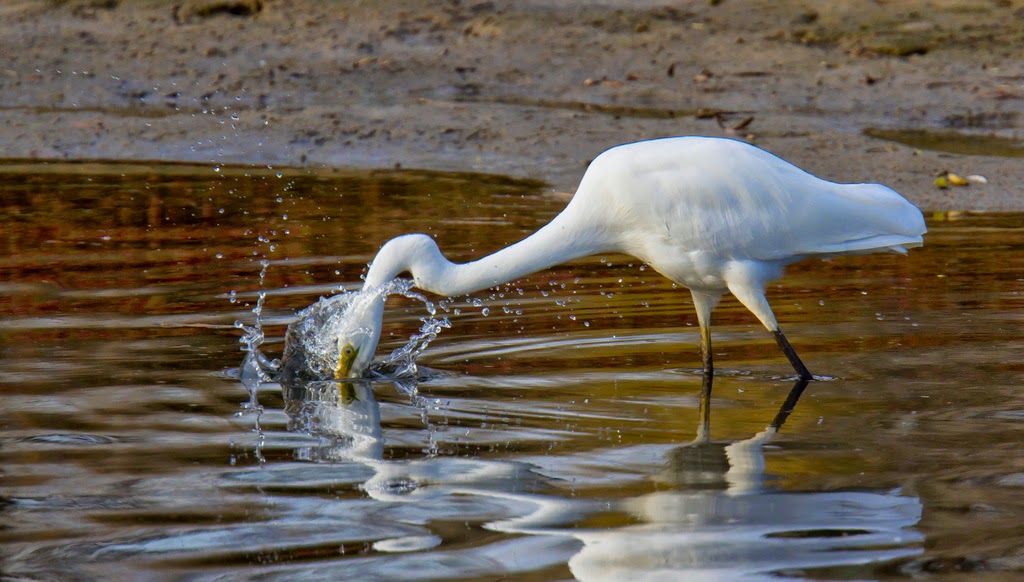
Whoa! Great Egret Aerobatics

I made a brief diversion to Gould's Lagoon recently, while returning from a trip to New Norfolk. I had little time for anything but a quick scan, but seeing the resident Great Egret close to the highway, I couldn't resist getting out and taking a few shots. While it usually puts up with passing pedestrians, it was suspicious of my intentions, as you can see (top left image). However it allowed me to take a few shots before it flew a few metres, landed and carried on feeding. As I stood deciding whether to try for more shots, it took off again, calling with the usual croaking call, as it climbed ever higher, then circled some hundred metres or more over the lagoon. I watched, wondering whether I had been responsible for this action--I get, perhaps justifiably, paranoid about overstepping that indefinable line between legitimate watching and harrying birds, especially when attempting photography. So I stood there willing it back down to the lagoon, when it went into a series of high speed dives and loops, pulling what in an aircraft, would be described as high g turns. Frankly, I've watched many hundreds of egrets, but this display can only be described as awesome! As you can see, I shot off a few images, albeit from some distance away. If you look closely at the images (by clicking on them), you may see the distortion of its' body, particularly in the neck, during these high speed aerobatics. The whole episode was over in a matter of minutes, and it soon descended back to the lagoon, and after a few laps round it, landed on one of the decaying nest boxes, close to the hide. I returned to my car, quite relieved that the egret had returned, but still puzzled by the event. My thoughts as I drove back, were that perhaps it was a reaction to a predator, possibly a Peregrine Falcon, the local White-bellied Sea Eagle, or one of the overwintering Marsh Harriers, unseen by me. Perhaps you may have seen a similar display and have a better explanation. An interesting brief visit.

Monday, June 02, 2008

Another Tick--but only just!

I received an email from Bill Wakefield on Sunday morning, saying that Tim Reid had reported a Pink-eared Duck on "Lake Chook" at Gretna (I assume the name is an unofficial birder name!). Unable to check it out on the weekend due to family commitments, today (Monday) I opted for an early morning start. Well, in my eastern shore suburb, it was bright and sunny, so I set off with high hopes of seeing said bird. But....the whole of the Derwent Valley was in thick fog. Being a supreme optimist, you have to be to photograph birds, I kept going, telling myself the weather at Gretna would be clear. Wrong!
The stretch of water concerned, is a large farm dam, opposite the Gretna village hall. At the moment, being one of the few stretches of water still extant, due to low rainfall, it holds good numbers of waterfowl. Arriving, my heart sank, visibility was extremely poor, with a thick mist over the entire area that, in the very still conditions, was unlikely to lift for some hours. I pulled off to the side of the road and scanned the area. Numbers of teal, shoveler, black duck, coot, Hoary-headed Grebe, and Black Swan, but no pink-eared. There was obviously many other birds further down the dam, but in the conditions they were just ghostly blobs. At the risk of scaring everything, I got out of the car and walked down to the fence, hoping that would enable me to 'see' a little further down the dam. Little stirred, except a solitary Black-fronted Plover calling--I think they were having trouble seeing me! I scanned again, just being able to make out 4 Hardheads on a small islet, mid water. I was fast coming to the conclusion that this really was a waste of time, but thought I'd have one last scan. Voila! The unmistakable outline of a Pink-eared Duck, about a hundred metres away! Must get a record shot, just to prove I did see it--top left. (Yes, I know it doesn't look foggy, but that's entirely down to digital imaging, for which I'm truly grateful).
Pink-eared Duck are considered a rare vagrant in Tasmania, and Bill tells me that this is only the 8th record for the state. From memory, most of the records have come from the far NW of Tasmania. It's also my first sighting of this species in Tasmania, and I've been around a long time! My thanks to Bill and Tim.

Thursday, May 29, 2008

The Bread Run

Every other day, I do a 'bread run'. None of this pre-packaged bread for me, only the 'proper' stuff. So it was today, on a heavily overcast morning, with the hint of much needed rain, that I did my run. I always take my camera with me, and do a drive round the Bellerive waterfront, hoping for a possible photo op.. Nothing much about, even the usual gulls seemed absent, but I caught sight of a White-faced Heron, standing on the railing of the yacht club's pier. So out I get, and took a few shots, albeit in less than perfect conditions, but you have to take your opportunities. As I crept ever closer, I was suddenly aware of a commotion in the water beyond the jetty. A pod of around 20 Common Dolphin, obviously chasing fish, were passing, some only a few metres from the shore. I was a bit torn at this stage! Realising that I am rarely present at these dolphin moments, I opted to 'shoot' the dolphins, and ignore the heron. Well it soon became apparent that to take any meaningful shots would need better reflexes than I've got! Lots of shots of dorsal fins, not much else, save for a single shot of a dolphin leaping, taken by pure chance, as it was just beyond others that I was targetting! I, and a number of other bystanders, were given a great display, as the pod moved into Kangaroo Bay. I suspect their prey was probably Black-backed Salmon, but that's only an educated guess. In minutes they turned back into the Derwent River, still chasing fish, paralleling the shore for a few hundred metres and then out into deeper water. A great sight and a great adjunct to my 'bread run'.

Tuesday, May 27, 2008

Little Swanport Melee

Feeling in need of a field outing, I was somewhat frustrated by the forecast of rain for the Hobart area, with showers moving in from the West. So I opted for an early morning dash up the Eastcoast, which appeared likely to give me some chance of reasonable weather, albeit, only for a short while. On the road at sunrise, I arrived at the mouth of Little Swanport with some expectations, but as I surveyed the inlet from the boat ramp, apart from a solitary Great Egret, there wasn't much about. However, I was really looking in the wrong direction, because as I turned towards the inlet mouth, there, strung out across the entrance, was a good number of Australian Pelican and Great Cormorant, riding the substantial swell, and feasting on schools of fish. I rapidly drove off to the entrance, leapt out of the car, and started taking shots of the pelicans, realising as I did so, that the schools of fish were moving down the inlet and taking the birds with them. If only I had arrived just a little earlier--the story of my life! In about ten minutes there were only a few birds remaining, but a couple of Australasian Gannet, fishing just outside of the breakers, gave me some chance of getting a few shots, so I walked out to the headland and waited. As you
can see from the accompanying shots, I managed a few distant shots, including one in a dive, just about to hit the water. I watched the gannets closely as they fished around the bay, noting their fishing methods, particularly how they use their tail as a dive brake by depressing it, causing them to stall and slowing them down. A quick hover, followed by their spectacular dive and plunge--magnificent! I've watched as large flocks of them repeatedly plunge dive, sometimes from only a few metres above the surface, presumably when their prey is near the surface, or in shallow water. Neither of the 2 gannets in the bay came really close, as I'd hoped, but they were certainly still worth watching.
Back down the inlet, some of the pelicans and cormorants, now joined by Crested Terns and the odd Kelp and Pacific Gull, were fishing close to the boat ramp, so I made another quick drive to close on them. Most of the Great Cormorants were now drying out on the sandbanks, probably having had their fill of fish, leaving only an odd bird or two fishing, along with tens of Crested Terns and a few pelicans. It's always a somewhat frantic scene, as some of the hapless fish, in this case mainly Garfish, come up to the surface, giving the birds their chance of a feed. It's an all in melee, often only for a few minutes, before the fish are sighted elsewhere, causing another frantic chase. Whether caused by frustration or perhaps a reaction, I noted the confrontation photographed at lower left. A Great Cormorant surfaced close to the pelican, garfish in bill. This immediately caused the pelican to set off in pursuit of it. The pelican quickly overhauled the cormorant, landed on top of it, causing the cormorant to dive. The pelican failed to acquire the fish, but it did leave me wondering why it had bothered. Perhaps the schools of fish were in too deep water for the pelican to successfully catch them, or perhaps this is a quite normal occurrence.
I had only been at Little Swanport for about an hour or so, and by now the pelicans were fishing well down the inlet, in much shallower water, better suited to them, and the weather was closing in. Time to leave. A well worthwhile trip, my only regret was not arriving sooner. I stopped off briefly at Rostrevor Lagoon, near Triabunna, on my way back. The water level is very low--both Orford and Triabunna have water restrictions at the 'critical' level, and perhaps not surprisingly, the lagoon is a refuge for waterfowl, and there were some hundreds there. Of particular interest was the presence of 24 Blue-billed Duck and 17 Hardheads, both species uncommon in Tasmania, although Rostrevor Lagoon is one of the more reliable venues for seeing them.

Friday, May 16, 2008

Tasmanian & Brown Thornbills

I've been setting up a pbase site of bird photographs, during a recent bout of illness. While doing so, I happened to find a few similar shots, taken in similar lighting conditions, comparing two of what appears to be, among the more difficult Tasmanian birds to separate. I say appears to be, as I've noted a spat of reported sightings of Tasmanian Thornbills in areas and habitat that are not "usual"--no names, no pack drill! While I'd not like to say that they could never occur at these sites, they appear to be recorded by visitors to this state, which makes me 'uneasy'! I'm not setting myself up as an expert, merely hoping that the accompanying images will help separate two similar species. Tasmanians on the left, Browns on the right.
There appear to be a few obvious differences--easy when you have images and not looking at birds in the canopy or against the light. The Browns are much better marked on the breast, and they have noticeably larger bills. The undertail coverts are light brown in the Brown, and white in the Tasmanian--t
his has been one of my diagnostic points to look for, often very noticeable in the Tasmanian, as they are often seen 'fluffed ' out. I would be disinclined to use any colour differences you may note, as the vagaries of my image editing, and the differences of screen colour settings, will influence this.
So if you're looking at 'brown' thornbills in Tasmania, I suggest you go for a couple of the diagnostic points, to satisfy yourself of the species. In the main, the endemic Tasmanian Thornbill will be in wetter, more heavily forested areas, especially in the South East.
The Tasmanian Thornbill images were shot in the Wielangta Forest, and the Browns in the Peter Murrell Reserve.

NB.If you're interested in looking at the Tasmanian Bird images that I'm currently inputting, you may find them at www.pbase.com/tassiebirds , I will eventually put a link in. The site is still under construction.

Sunday, April 27, 2008

Tinderbox, Still Worth a Visit

Late last week, I had occasion to visit Kingston, and not wishing to waste the opportunity to go birding, I left early and planned a side excursion to Tinderbox. Once, a few decades ago, Tinderbox was synonymous with Forty-spotted Pardalote. Since then, the area has been developed, largely with low density housing,and birders wishing to see 40 spots, have usually visited the nearby Peter Murrell reserve. Not dressed for birding, I reasoned that I could bird from the open area adjacent to the WW2 gun battery site, and I wasn't disappointed.
I arrived around 8am, on a beautiful still day, marred only by the smoke haze from Forestry burns that have covered SE Tasmania for several days. Initially I sat in the car listening, birding is often more about listening than looking, but apart from several guttural calls from a nearby Yellow Wattlebird, not much stirred. I wandered down towards the light overlooking the mouth of the Derwent River. I picked out calling Crescent Honeyeaters, the "tok-tok"call of a Yellow-throated Honeyeater, and a group of Black-headed Honeyeaters, feeding in the canopy of nearby Blue Gums. I heard, then saw, the first of many Spotted Pardalote, several chasing one another. I should mention here that, unlike last Autumn/Winter, when they were numerous, I haven't sighted a single Striated Pardalote since mid March. Walking towards the edge of the woodland, I stopped to watch and photograph, a passing Eastern Spinebill (bottom photo), one of several, mostly feeding on the red flowers of a small prostrate plant, that I should know the name of, but don't! Several small flocks of Little Wattlebirds passed overhead, as did a Peregrine Falcon, causing the whole woodland to fall into silence. I walked back up the hill towards the road. Here I watched the antics of a flock of New Holland Honeyeaters, mostly defending feeding rights to certain trees, chasing off other New Hollands, or any other birds that trespassed. Then, with much noisy chattering, they would all cluster close together in a huddle, before noisily breaking up to return to their territory, quite comical at times. It was while watching the honeyeaters that I heard the contact call of the Forty-spotted Pardalote, and saw the first of several, this one being chased out of a euc viminalis by one the honeyeaters. Despite that, the 40 spots were pretty determined, and shortly returned, and I spent the next 20 minutes watching them. As with the Spotted Pardalotes, there was a lot of chasing going on, which I assume is related to pairing. Although feeding mostly amongst the outer foliage of their chosen eucalypts, and often hard to watch, I did manage a few shots of them (not brilliant!), including one showing 2 birds (image on the right), something of a first for me! I must say that I had little expectation of seeing any 40 spots, let alone photographing them, so that was a bonus.
So perhaps Tinderbox is still worth a visit, at least at this time of year. As a sequel to this, I stopped about a kilometre down the road towards Blackman's Bay, to talk to an old friend, and saw yet more 40 spots, so there appears to be a good few about.

Tuesday, April 22, 2008

A Tale of Two Wrens

Two recent outings saw me coming to grips with two of Tasmania's more elusive wrens. The first was during a search of the western side of the Derwent for recently arrived egrets. At my first stop, Gould's Lagoon, I did manage to find a single Great Egret and a single Cattle Egret roosting in the dead tree normally occupied by cormorants. The Great Egret flew from that tree, shortly after I arrived, and joined 3 other "Greats" flying upstream above the river. I moved on to New Norfolk, hoping to see the usual small flock of Cattle Egrets feeding in the irrigated paddocks on the outskirts, but drew a blank. A little deflated, I dropped into the Old Hop Field reserve, specifically to the sewage ponds, where a surprising range of birds may be seen, including the Yellow-throated and Black-headed Honeyeaters, and Yellow Wattlebird (all Tasmanian endemic species), robins, Native Hen, the occasional Dusky Moorhen, Chestnut Teal and Black Duck. Noting a male Superb Fairywren still resplendent in full adult plumage, I tried
closing for a photograph. I scrambled a couple, before being scolded by a Tasmanian Scrubwren. I was a little surprised to find one here, among the willows lining the creek, with blackberries and hop plants forming a dense mass in between, much of it now acquiring that attractive golden Autumn look. Perhaps inured to passing humans, it reacted well to 'pishing', and I took several shots, two reproduced here (2 upper shots). They're seldom easy to photograph, being very active and occupying the shadier situations, so I was glad to make the most of it.
The following day, I drove down to Goat Bluff, near South Arm. I was interested to see whether the Flame Robins were still present, as some of these robins form flocks, and part of the local population migrates to the Mainland. Wandering round the light scrub on the eastern side of the bluff, I found a solitary 'brown' Flame Robin, so most of the several pairs that had territories here, appear to have moved elsewhere. Watching this Flame Robin singing from the top of a fence post, I noticed another bird, also singing, on a fence wire a few metres from the robin. Nearing the two songsters, the robin flew, leaving the other, a Striated Fieldwren. As I watched it from a few metres away, I realised that there were at least 2 other fieldwrens in the area, also singing, in their case from on top of low bushes. I was pleasantly surprised that, in general and with care, I could get close enough to get acceptable images, two of which are shown (2 lower images). As I have found on other occasions, in sunny still conditions, almost year round, these fieldwrens call from conspicuous perches, presumably to establish or reinforce their territories. In between bouts of song, they would forage on the narrow tracks, often running along the tracks with amazing speed.
So despite failing to achieve what I had set out for, on both outings, it was pleasing to get to photograph 2 birds that often prove difficult. Both species are common, in suitable habitat, in Tasmania, but, particularly the fieldwren, can prove difficult to find, notably when you're trying to find them for visiting birders!